Project Understudy
A segmented snake robot that fits under a door, anchors to the floor, and opens it
The Job
A closed interior door stops most ground robots. The gap underneath is usually under a centimetre, and the handle is a metre up. Understudy is built for exactly that gap. It is a segmented, suction-anchored snake that fits under a standard door, crosses to the far side, anchors itself to the floor, and then opens the door. For a lever handle it pulls the lever down. For a push-to-open door it sticks cups to the leaf and pulls.
The anchoring is the part that makes it work. A snake with nothing to brace against cannot pull a handle, because it just drags itself toward the door. Sticking to the floor first turns the whole body into something that can apply force to the door instead of to itself.
I am building this for search-and-rescue and assistive access. It operates unlocked lever handles and door leaves only. Nothing in the project attempts to defeat a lock, a latch bolt, or a deadbolt, and nothing in it would help anyone do so.
What Is Actually Done
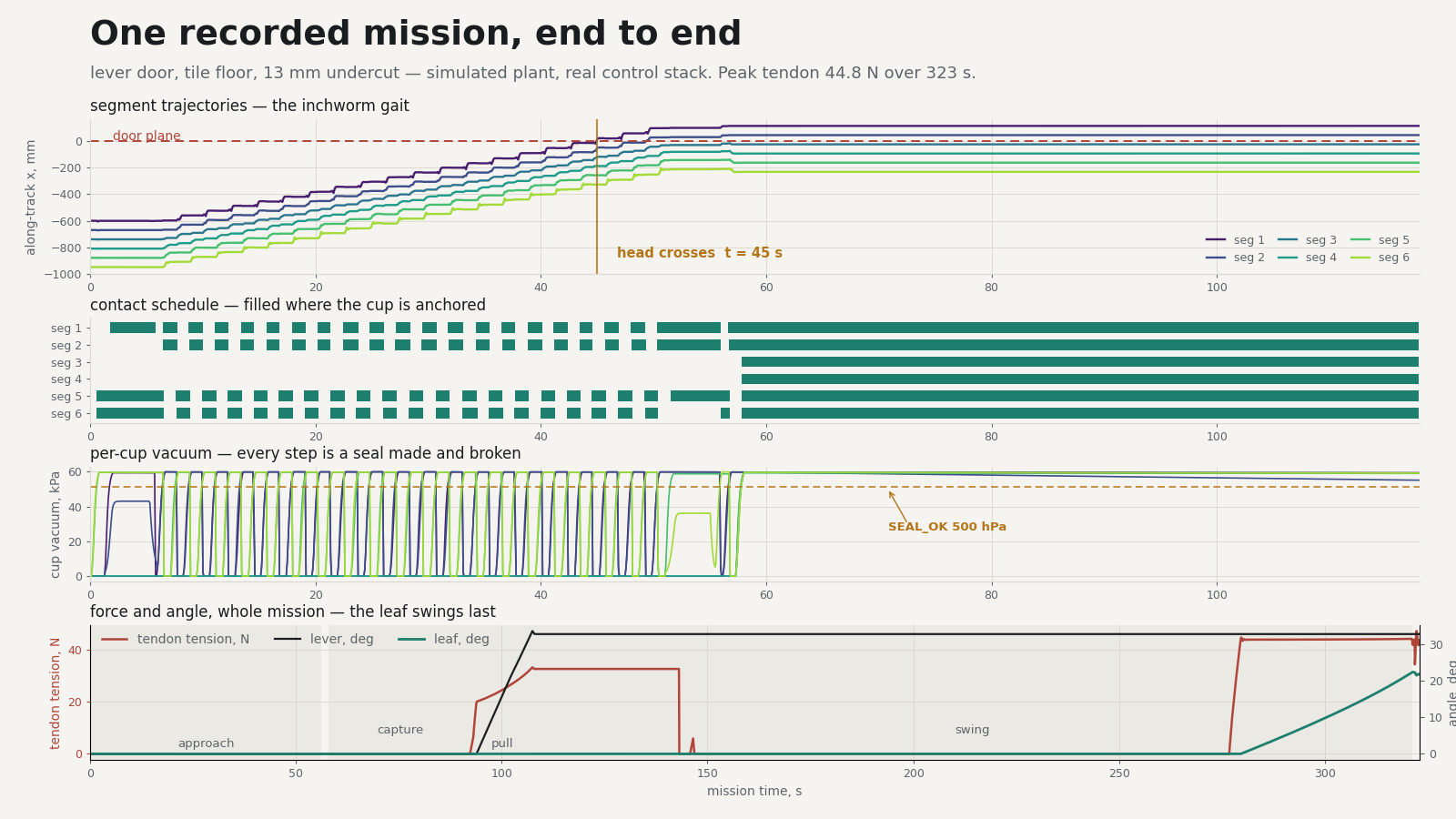
The software is complete and the hardware is not. The whole control stack exists: bus protocol, firmware state machine, safety interlocks, gait, and mission sequencing, all exercised end to end against a physics simulator. The robot opens the door in simulation. It has never touched a real cup.
I keep a gates document that records exactly what has and has not been demonstrated, so the line between simulated and built stays visible rather than blurring over time. A separate findings document records what the models said that the plan did not.
Design That Survives Contact With a Bill of Materials
The build is print-ready: eight plates and 241 grams of PETG, with a picking list of every part, tool, and consumable, and counts derived from the same inventory the simulator uses. That last detail matters more than it sounds. Because the simulator and the parts list read from one source, a part that exists in the model has to exist in the build.
The wiring document is generated from the electrical inventory with every budget computed rather than written by hand. Doing it that way found four things that the bill of materials and the CAD each assumed the other was handling.
Next
Printing it. Every number on this page comes from simulation, and the interesting part begins when a real cup meets a real floor that is dustier than the model thinks.
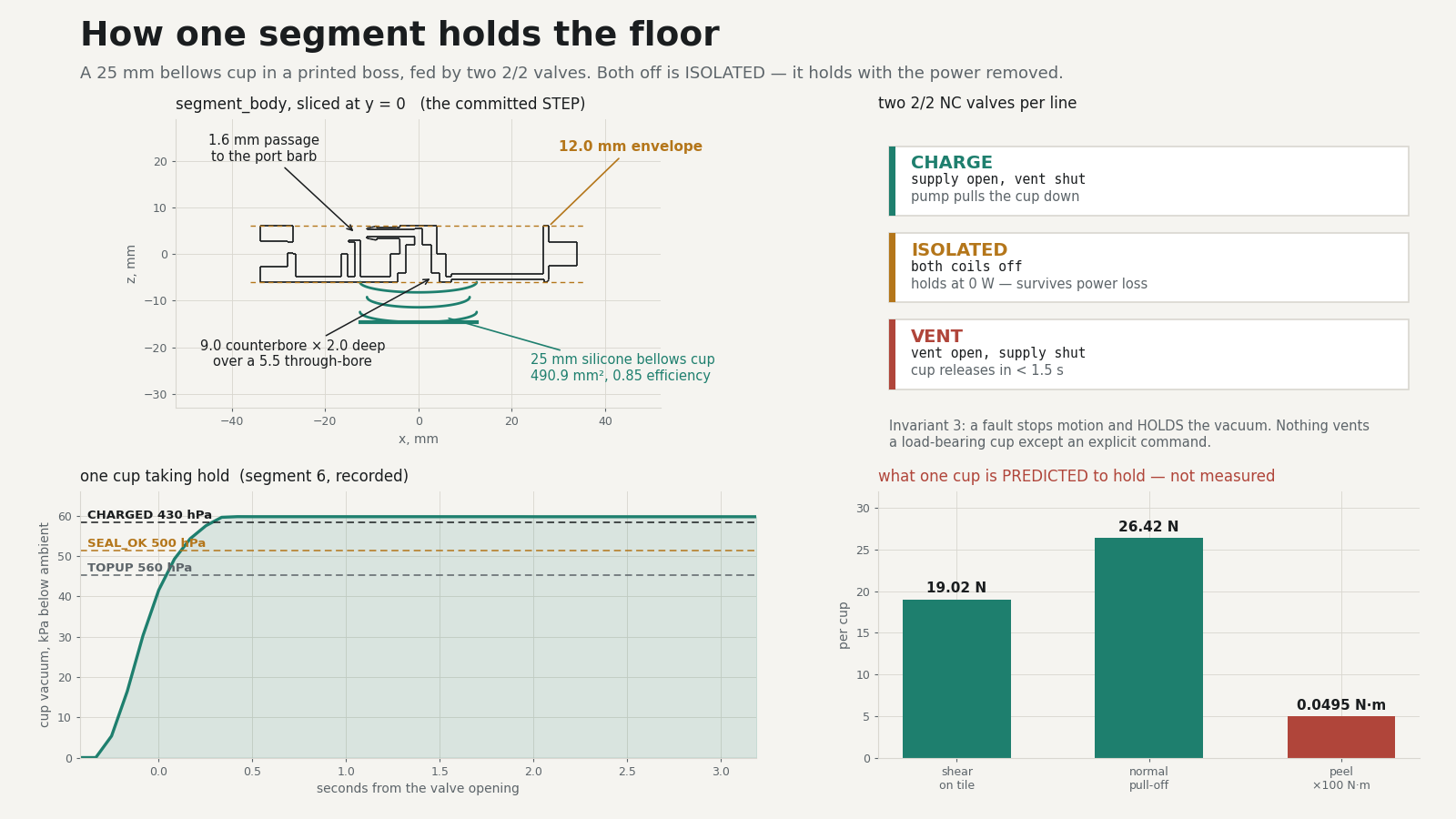
Three things the models settled. The chain envelope is 12 mm and the run shown clears a 13 mm undercut, so the whole design lives inside one millimetre of margin. Across a twenty-door catalogue, 15 clear that on a flat floor, and only 9 of 20 once you put a 1 mm threshold strip under the leaf. Six segments turned out to be the minimum that can move at all: the two-segment configuration the plan originally called for has a measured stroke of 0.0 mm per cycle, because the rear half undoes whatever the front half does. That is the scallop theorem rather than a tuning problem. And the anchoring force per cup is predicted rather than measured, which is the first number I would want a real cup to argue with.